Why Modern Marketing Strategy Demands Segmentation and Long-Term Trust
Beyond Surface-Level Advertising: Organizational success in digital commerce relies on knowing exactly who you're talking to. This article dissects why the traditional AIDA model fails to capture the modern customer lifecycle. It argues for replacing it with a strategic focus on segmentation and relationship maintenance, ensuring every communication reinforces brand awareness and drives repeat business.
CONTENT CREATIONDIGITAL TRANSFORMATIONJOB SEARCHMARKETING & COMMS
Aria Guzu
12/5/20243 min read


I find that the fast-paced world of digital transformation and international commerce demands two things simultaneously: absolute clarity in strategy, and the resilience to execute that strategy amidst chaos. This contrast is never more apparent than in marketing. As someone who functions naturally as an internal business analyst, I am always seeking to identify the core drivers of organizational success. And for marketing, I believe success lies not in shouting louder, but in knowing precisely who you are talking to, where they are listening, and how to build a relationship that lasts.
My International Business studies, combined with my hands-on experience in managing complex, multi-stakeholder environments, showed me that organizations often fail when they attempt to market to everyone. They dilute their message and waste precious resources. The solution? Rigorous market segmentation and the strategic application of tailored communication.
The Segmentation Imperative: Reed.co.uk example
I believe that for any large company, particularly one operating in complex markets like recruitment, market segmentation is the crucial first step to achieving a competitive advantage. It is not enough to simply separate audiences into broad categories, but to segment based on explicit need.
I studied Reed, a UK-based recruitment company that successfully segmented its market horizontally and vertically. They started by separating corporate clients (job creators) from individual clients (job seekers). But they didn't stop there. They recognised that the required communication style changes dramatically depending on whether the customer is a highly qualified professional (a specialist) or an experienced generalist.
This nuanced approach allowed the company to establish brands within a brand. This is a masterful move of strategic positioning:
• They created professional divisions (like 'Specialists') targeting corporate clients, demanding a formal and professional tone.
• Simultaneously, they maintained an informal, relaxed brand ('Recruitment') focused on the general public.
This dual branding ensures that the company successfully fills all relevant fields on the positioning-perception map, guaranteeing that its core brand promise (like the famous "Love Mondays" slogan that became viral) reaches every single segment in an authentic and tailored way.
Evolving the AIDA Model: The Need for NAITDASE
For decades, the traditional AIDA model (Attention, Interest, Desire, Action) served as the foundation for measuring marketing efforts. However, I believe technological innovation has fundamentally changed the consumer landscape, moving us from product-oriented techniques to people-oriented marketing. The simple AIDA funnel is no longer sufficient; we must capture the customer’s entire life cycle.
I found that the more evolved model, NAITDASE (Need, Attention, Interest, Trust, Design, Action, Satisfaction, and Evaluation), offers a framework much better suited to modern business.
The fundamental shift, for me, is the inclusion of Need as the starting point. Studying Reed and their strategy, I learned that focusing communication on solving an existing problem - whether it is advice on improving a CV or information about wellbeing at work - is what triggers genuine engagement and draws attention.
Crucially, the latter stages of the NAITDASE model highlight the long-term strategic commitment necessary for success:
1. Trust: Constant, positive interaction with a brand across various channels is what builds trust, which is paramount when handling sensitive personal information.
2. Satisfaction and Evaluation: For a company dealing in long-term relationships, like a recruitment agency, the pipeline does not end with the 'Action' (purchase/placement). I believe the relationship lasts until the individual retires. Therefore, every communication effort must be designed to reinforce brand awareness and drive satisfaction, linking directly back to the strategic objective of long-term stability and repeat business.
This emphasis on continuous engagement and relationship maintenance aligns perfectly with my own operational principles: I seek to build long-term value, whether that means negotiating contracts to strengthen relationships with clients despite a shipment crisis or streamlining complex processes using data to ensure operational efficiency.
The Multi-Platform Communication Divide
Implementing a multi-segmented strategy demands discipline across every communication platform. Applying a mix of communication channels and styles is effective, even though it may initially be associated with high costs and a low return on investment in the short term. But guess what? Efficient communications and stakeholder management is perceived to be one of the most valuable skills for a person or a company.
My analysis showed a clear communication divide dictated by the audience present on each platform:
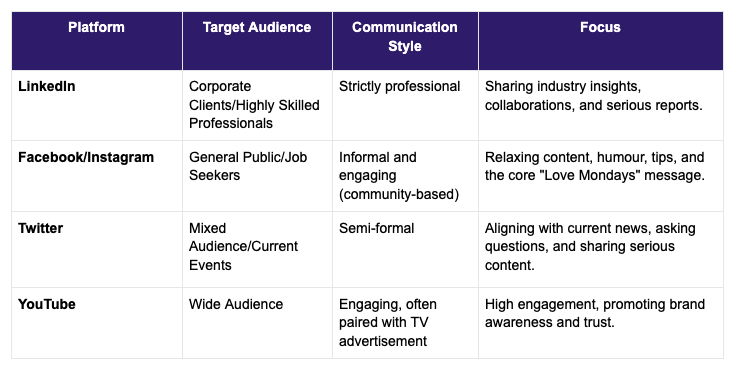
This tailored approach ensures that whether a potential client is seeking industry insights on LinkedIn while sipping their coffee or scrolling through humorous content on Facebook during their lunch break, the brand is constantly present, providing value and reinforcing trust.
Ultimately, successful marketing, much like successful project management, is about managing diverse streams of information and aligning them to a unified, long-term strategic vision. It requires continuous intellectual stimulation and the freedom to explore creative, unconventional solutions that move beyond the surface level of mere advertising. That dedication to strategic clarity and execution is what I believe allows a company not only to survive but to truly thrive.Write your text here...