How to Be Strategic About Operations Management: A Non-Business Person's Guide
Operations Management for Non-Experts: Aligning Every Task with Strategy. Going beyond daily tasks, OM requires defining the strategic 'Why' first. Learn the fundamentals: defining your Competitive Strategy (Cost, Differentiation, Focus), the SMART planning process, and the core role of the PID. This guide provides the basic framework for aligning every resource decision with high-level business goals.
CAREER DEVELOPMENTMANAGING CHANGEGROWTH MINDSETPROJECT MANAGEMENT
Aria Guzu
1/25/202510 min read


Operations management (OM) is the art and science of ensuring your business efficiently delivers its products or services. Being strategic about OM means aligning every daily task and resource decision with your overarching business goals, ensuring consistency, maximizing efficiency, and managing risk. This guide offers basic guidelines for approaching operations management, even if you are new to the business world.
1. Where to Start: Defining the Strategic 'Why'
Before focusing on what you do (your operations), you must define why you are doing it (your strategy). Starting strategically involves defining the core purpose and aligning it with your overall vision.
Define the Need and Desired Outcome
The very first step for any project or operation is for the Senior Responsible Owner (SRO), or the person identifying the need, to define and justify the need for the project and specify the desired outcome and benefits.
Determine Your Competitive Strategy
Operations must support a clear, generic competitive strategy, typically falling into:
Cost Leadership: Focusing on achieving the lowest cost in the industry.
Differentiation: Offering a unique product or service that stands out.
Focus: Targeting a specific niche market.
Inconsistent or frequent changes in competitive strategy can be costly, less efficient, and confuse customers and stakeholders. Most importantly, you must avoid being "stuck in the middle," where a firm fails to achieve either cost leadership or uniqueness, resulting in low returns.
Adopt a Holistic View
To connect operations to strategy effectively, you need a holistic perspective that involves looking at the micro-level (day-to-day processes) and the macro-level (industry and overall strategic context). A key operations strategy perspective is the "Top-down" approach, where the operations strategy interprets and aligns with the higher-level goals of the organisation. If you’re at the top of the food chain - go for it.
Personally, if you are confident about your professional background, the industry/company you are in, but are not exactly a C-level or senior management on an organisational level, I strongly recommend the “Bottom-up” method. Let me explain to you why.
I had many projects that were handed down to me from senior executives - highlighting the strategy, overall benefits to the organisation, how they wanted to get things done and the budget and other resources they allocated. When you start working on your project, it all looks great - everything has been given to you, and you have a clear strategy. But here’s the catch: executives often think at a higher level (strategy and vision), which means they might not necessarily have the daily know-how, as well as the command of the exact costs or resources for a specific item or task. Batch all of these things together, and you have a massive gap in budget or human resources allocated.
If you get top-down decision-making in your organisation, it’s up to you to immediately detect any discrepancies and correct the project plan, ask for more resources, etc. But that means you need to know. And let’s be honest, sometimes it’s not quite possible. Nevertheless, if you accept this kind of project, and later find out you don’t have enough time, money, resources, etc., it’s up to you to creatively bridge the gap. When the project starts crumbling - exceeding budgets, not meeting quality expectations or lagging behind the timelines - it will be perceived as a failure by the project or operations manager.
So, my recommendation: if you can, always do a bottom-up proposal. If you know a project is coming, start researching: what are they expecting, how fast, what is the scale, what quality are we talking about, etc. It has not started yet, so you don’t need to be meticulous, but getting an idea about costs, timelines and what resources you would need will help you to make a quick, informed decision during project planning meetings. And if your organisational structure allows, it will also help you to prepare a good bottom-up proposal, so then you can be in control and act as a subject matter expert. It will need several iterations, and senior management will have their own ideas, but at least it will place you in a better position: you can get adequate resources, you will be more in control of your project, and you will be in a good position to manage expectations.
Here’s a good resource to read more about “Top-down” and “Bottom-up” approaches - see what works best for you!
2. How to Think and Plan: Following a Structured Process
Strategic planning for operations follows a structured approach, allowing you to move from a broad idea to an actionable, controlled plan.
Phase 1: Initiation and Blueprint (The Project Brief)
The effort devoted to project start-up and initiation makes the most significant contribution to project success. This phase captures the basic framework in a Project Brief.
1. Define Scope and Objectives: Clearly state what is in scope and out of scope to prevent drift ("scope creep"). Your objectives must be SMART:
Specific to the project.
Measurable (e.g., reduce turnaround times by 20%).
Achievable given practical constraints (technology, people, time).
Relevant to the bigger organisational picture.
Time Bound (having a target date for achievement).
2. Outline Risks and Constraints: Record any known risks, constraints (like resource availability or mandated dates), dependencies on other activities, and initial estimates for time and cost.
3. Appoint Leadership: Ensure a Project Manager is appointed, and the SRO/Project Board commits to the project's direction.
Phase 2: Detailed Planning and Justification (The PID)
The Project Initiation Document (PID) builds on the Project Brief by defining in detail how the project will be delivered. I know how many professionals complain that project/operation managers are so extra just because of all the admin work we create. And I understand. But what’s important here is to establish a clear structure and have guidelines: this is what we are doing and this is the outcome we expect; these are the reasons why the current process/system/state is not satisfactory - and these are all the great improvements (cost, quality, time, job enrichment) we will observe once finished; finally, this is how we are going to do it and these are the ways we will manage risks, stakeholders, processes, change, training and support, etc.
To put it into a structured format, this is how we would execute:
Develop the Business Case: This justifies the project by documenting costs and anticipated benefits. It confirms the project is worthwhile, viable, affordable, and consistent with high-level strategy. For complex or large projects, this should include an appraisal of different options, including the 'Do Nothing' option.
Detailed Planning: Specify the necessary activities, put them in a logical sequence, estimate required resources (people, skills, money), and schedule the work. For larger projects, break them down into manageable "stages" to minimise risk and allow for frequent review by the SRO/Project Board.
Process and Capacity Analysis: Assess current operations to identify inefficiencies and bottlenecks. For example, by analysing the steps required to complete a job (like site surveys or installation), you can identify the slowest step—the bottleneck—which dictates the maximum output capacity. Techniques like Economic Order Quantity (EOQ) can be applied to procurement and inventory to find the ideal amount to order to minimise overall costs (ordering, holding, unit costs).
Governance and Controls: Define how the project will be monitored and controlled, including reports, decision points, and how problems (issues, problems, changes) will be handled.
Phase 3: Execution and Control (Running the Project)
Once the PID is approved, teams execute the plan.
Monitor Progress: Regularly monitor progress against the plan and resource usage. Use structured reporting (like Highlight Reports) to inform the SRO/Project Board of status.
Manage Risk: Focus equally on potential threats and opportunities. Risk management involves identification, evaluation (impact and likelihood), and continuous monitoring throughout the project life.
Maintain Flexibility: Be prepared to re-plan in light of experience, as projects rarely follow the exact route modelled in the initial plan. Creative problem-solving under pressure is often required, as demonstrated when logistical crises occur (e.g., spoilage or vehicle breakdown).
I find that execution often doesn’t go as planned - even if we planned with plenty of time and have relevant experience. There will always be issues with the raw material, delivery times, contract signing, software launch, unexpected system issues or user onboarding or adoption. It’s crucial to track every activity throughout our project life-cycle: if we have established KPI’s, Gantt Charts, and dates for milestones, it will be easy to capture if something is running behind. Make Monday, Trello, MS Project or similar tools your best friends. Not only can they streamline your work through efficient collaboration with colleagues, but it will also visualise your projects and operations, allowing you to pivot and implement controlled change to mitigate risks and/or improve your outcomes.
Phase 4: Finish and Review
Closure: Ensure formal project closure, including a Lessons Learned review.
Benefits Realisation: Crucially, ensure that operational managers "own" the expected benefits and a plan is in place to measure their achievement after the project is complete.
I always emphasise the importance of taking the time to review your project. Go through your processes, KPIs, and documentation - and objectively evaluate your performance. What did you - and your team - do well? What could have been done better? Were there any deviations regarding quality, time or cost, or perhaps you’ve experienced a scope creep? Every project will make you better, but it’s important to take time and process all this valuable information. Lastly, don’t forget to share it with the team.
3. What Skills and Knowledge to Prioritise
To become strategically effective in operations management, you should prioritise skills that combine rigorous analysis with flexible, resilient leadership.
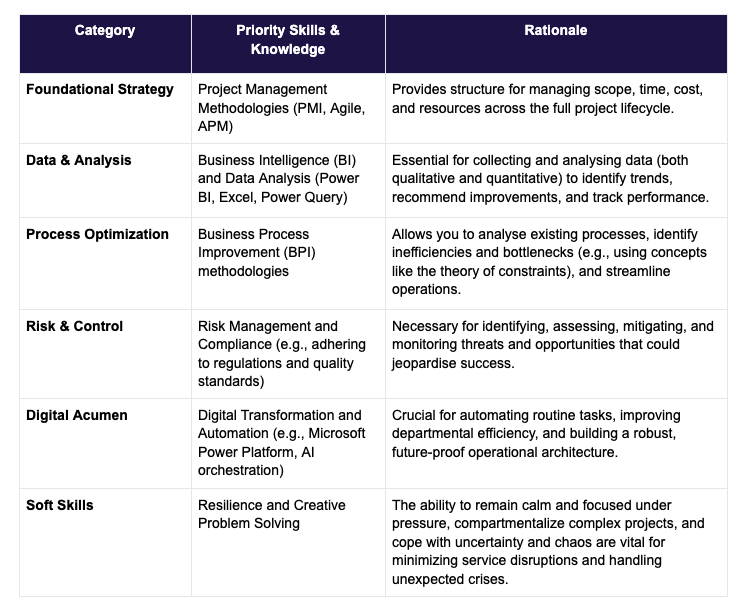

A career in operations management demands a diverse set of skills and knowledge to ensure smooth and efficient processes. Foundational Strategy requires understanding Project Management Methodologies (like PMI or Agile) as it provides the structure for managing all project aspects. All jokes aside, if you come from a traditional education background, chances are you were exposed to classical strategy resources. When you start working in business, you realize that these old and dusty strategies are actually worth studying. A few classics I myself like:
Porter’s Five Forces to achieve competitiveness in the market: Competitive Strategy: Techniques for Analyzing Industries and Competitors by M. Porter
The classic of all classics: Art of War by Sun Tzu
Anything written by R. Green: a good place to start would be 48 Laws of Power
I highly recommend reading something about negotiations and efficient stakeholder management: Learning to Negotiate by Georg Berkel is my go-to
When it comes to daily operations, methodologies and movements in the market, it’s best to keep up to date through newspapers, magazines, the TV, etc. I absolutely love WIRED and The Business Insider. I believe they give me the main insights I need to know. I then keep up with the local news of the countries I live and work in - and it keeps me well informed, so I’m aware of what is happening and if it could impact my projects in any way.
Another important thing is Data & Analysis, including Business Intelligence tools (from Excel to Power BI, Tableau, R, etc.).It is crucial for collecting and analyzing information to identify trends and recommend improvements. Depending on the organization you work for, you might have a whole data team. But it’s still important to know what data is relevant to your processes, projects and also what is crucial to the stakeholders.
Process Optimization knowledge, particularly BPI methodologies, is vital for analyzing existing workflows, identifying bottlenecks, and streamlining operations. That is closely related to Data Analytics and Business Intelligence. If you know how your current processes work and what performance data they produce, you can think of ways to improve your efficiencies, reduce waste and/or save time, cost or increase quality/output.
Risk Management and Compliance are necessary for identifying and mitigating threats that could jeopardise success. If you’re working in areas like Digital Transformation and Automation, it is becoming critical to automate routine tasks and build future-proof operational architecture. Think of Cybersecurity threats, GDPR, etc.
Finally, as much as we focus on technical and professional skills, it’s essential to work on developing Soft Skills like resilience and creative problem-solving. These are paramount for handling unexpected crises and ensuring minimal service disruptions under pressure. I had many hiccups when working in MedTech - service delays due to weather, equipment shortage, etc. I had patients misusing our medical devices, as well as devices not functioning as programmed, or sometimes our clinical staff would prescribe one solution, but in reality, the better option was another one.
It all sounds like a massive logistical and operational issue, but in reality, it can be softened with good communication skills and efficient stakeholder management. If you know your services and products, you can start building trust and communicating in a particular way: it allows to manage expectations, inform the stakeholders about the product, service and what could be the potential gains or losses, as well as to save time, money and effort if something does go wrong in the future and it grows into a legal issue.
4. How to Get the Strategic Plan for Your Operation
For those new to business, obtaining a strategic plan means following a documented process that rigorously links your operation to organizational goals and ensures buy-in.
Align with Higher Strategy: Ensure your operation or project is explicitly aligned with the organisation's overarching strategic/business plan. The goal is to avoid wasting resources on projects that do not serve the organisation's core purpose.
Research and Benchmark: Conduct extensive research and benchmark against other successful entities to gain context and ensure alignment with best practices. High-quality, data-driven insights are the foundation of any credible plan.
Stakeholder Analysis: Identify internal and external stakeholders and analyse their attitudes, involvement needs, and power/impact. This step ensures you gain commitment from the right individuals who must approve the plan and provide resources.
Draft the Business Case: Document the robust justification for the plan, ensuring it is viable, affordable, and provides value for money.
Formal Documentation: The resulting strategic document is the Project Initiation Document (PID), which formally defines the plan and serves as a "contract" between the Project Manager and the Senior Responsible Owner/Project Board. Approval of the PID signals the formal commitment to executing the plan.
5. From Start to Finish: Basic Guidelines for the Non-Expert
If you are running an operation for the first time, simplify the process by focusing on continuous iteration and control.
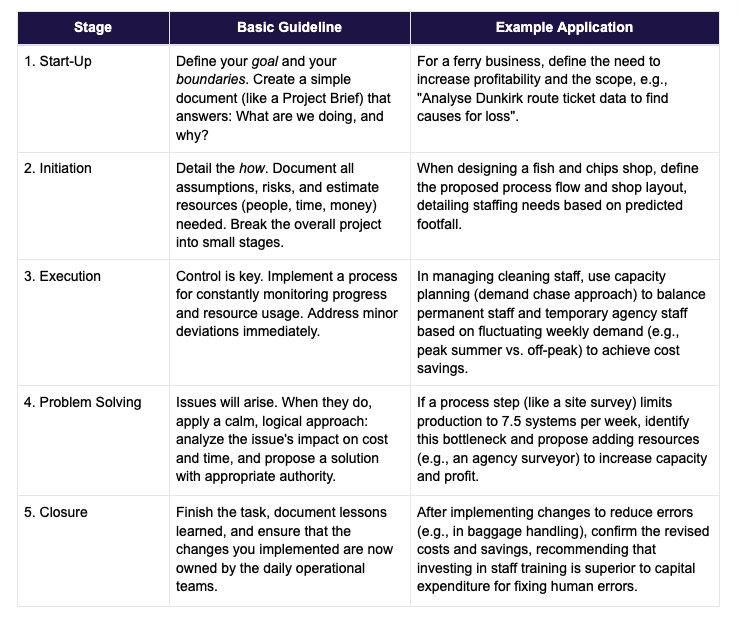

This comprehensive approach treats every operational task as a mini-project, ensuring that all actions are traceable, planned, controlled, and strategically aligned with delivering required outcomes and benefits. Strategic operations management is like planning a long journey: you must define your destination (strategy), map the route in detail (planning), and constantly check your navigation and fuel levels (control) to ensure you arrive successfully and efficiently.
Remember: even extensive planning does not guarantee your project will succeed or the service will reach the outcomes we anticipated. It’s a continuous growth. Keep up your motivation and focus to move forward with a growth mindset. Despite all, plan. Because he who fails to plan is planning to fail.