Green Computing: Why the Ethical Future of Technology is Human-Centred
Green Computing and the future of digital transformation, MedTech, business, and society as a whole
MANAGING CHANGEFUTURE OF WORKAITECHNOLOGYMEDTECHDIGITAL TRANSFORMATION
Aria Guzu
11/15/20243 min read
My post content
The modern economy is driven by continuous consumption. Over the last few decades, technological innovation has drastically changed most industries, leaving us highly dependent on information technology and artificial intelligence. While this progress has significantly improved our lives, it has also created substantial new challenges: electronic waste, data protection issues, and escalating operational costs associated with huge data centres.
I find immense intellectual stimulation in understanding these complex, evolving situations. I realize that if we are to keep up with the rapid pace of technological evolution, we must fundamentally change the ways we approach innovation management. That is where Green Computing enters the picture, offering a revolutionary direction.
What is Green Computing and What Value Does it Create?
Green Computing is not just a trend; I see it as the necessary long-term strategy that aligns information technology solutions with environmental sustainability, efficiency, and profitability. It is designed to maximize the efficiency of electronic devices throughout their entire life cycle, from design and manufacturing to usage and disposal, in an environmentally responsible way.
For organizations, particularly those managing large-scale operations or cloud data, the benefits are immediate and critical. We know first-hand that high energy costs plague organizations that store information in clouds and use vast data centres. The reality is that the IT infrastructure itself is becoming a limiting factor that determines how efficiently new equipment can be deployed to achieve strategic objectives (Wang, 2007).
I believe the core value Green Computing creates is resilience and operational efficiency:
1. Reduced Energy Footprint: Green architectural design is researching ways to develop more efficient codes that would reduce resource usage and environmental impact. One particularly innovative method is virtualization, where two or more logical systems are configured to run in one piece of hardware (Harris, 2008). This dramatically reduces the energy consumption needed to cool multiple devices, cutting organizational costs and slowing down hardware decay.
2. Financial Savings: Proactively considering environmental resource constraints pushes manufacturers to create devices that are more durable and easier to upgrade. Encouraging the replacement of specific components rather than the whole device significantly reduces the environmental impact and is cheaper and easier for the business.
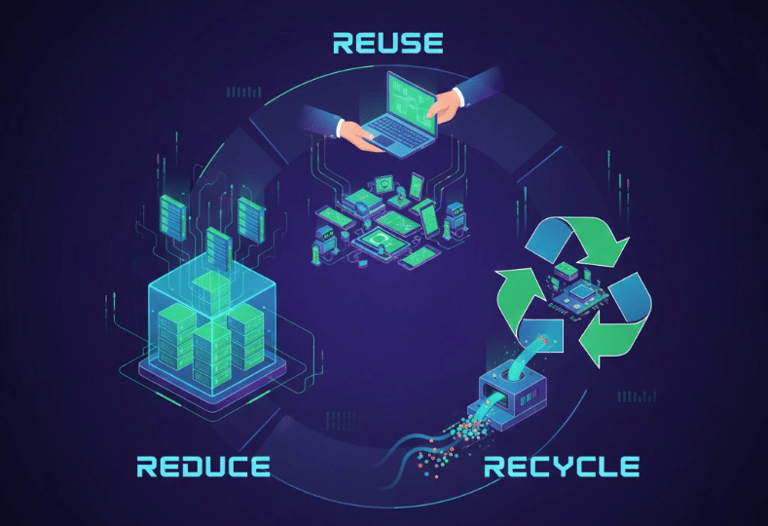
3. Long-term Sustainability: We must commit to the 3Rs model: Reduce, Reuse, Recycle. Recycling equipment (returning it to manufacturers) prevents non-recyclable materials from reaching landfills, allowing valuable metals to be reused in new components.
Where is Green Computing Applied, and Who Benefits?
The impact of Green Computing extends far beyond the bottom line of IT giants. I believe the greatest measurable benefits are currently found in the Government sector and social care operations.
During my time as a Business Officer at Cambridgeshire County Council in the UK, I managed the Technology Enabled Care (TEC) Lifeline Service, which supported independent living for over 2,000 residents. This service, which operates similarly to the American version of the HOD (Help Over Distance) app, saves costs by preventing or delaying hospital and care home admissions. However, managing all the necessary service user devices (like Tunstall, Essence, Chiptech or Footprint lifeline units) and government information systems creates significant energy and environmental challenges.
Applying a Green Computing strategy here directly benefits people and the public pocket:
• For the Government: I believe we must simplify our business processes to reduce our environmental footprint. Investing in a universal business information system (BIS) that merges different systems would unify the organization, reducing the overall number of devices and thus the necessary energy and cooling efforts. This approach sets an appropriate tone for other organizations, sharing positive practices and maximizing the use of taxpayers’ money.
• For the People/MedTech Sector: I champion prolonging the lifecycle of the MedTech equipment issued to vulnerable adults. Investing in good-quality, better-developed technological solutions offers long-term social and health care support. Suppose a device no longer suits one service user. In that case, it should be re-issued to another after a thorough audit, hardware cleanup and software re-install, ensuring we reuse assets and delay disposal.
When the Local Government’s HOD App aligns its objectives, offering high perceived value at a low cost, with environmental responsibility, it achieves what Bowman described as Strategic Differentiation.
What to Expect Next: AI, Automation, and a Sustainable Pathway
The next evolution of Green Computing is intrinsically linked to technologies I currently spearhead: Digital Transformation and AI. I am currently leading initiatives focused on deploying a future-proof AI architecture and agentic capabilities using the Microsoft Power Platform.
By driving business intelligence capabilities, systematically aggregating disparate data sources, and standardizing data formats, we enable algorithms to be processed more easily and more efficiently. This streamlining reduces system overheating and the required cooling efforts, which is a subtle but vital component of Green Computing.
Looking globally, my long-term curiosity about Asian culture and management practices offers an interesting philosophical parallel. While the West focuses on individual and short-term outcomes, I observe that Asia tends to think about society and long-term objectives. This mindset - integrating innovation like AI into society while following a sustainable pathway to serve communities for decades to come - is precisely the kind of long-term vision that Green Computing demands.
The future of technology will be defined not by the speed of our hardware, but by the efficiency and ethics of our infrastructure. Embracing Green Computing is the only logical and sustainable path forward for industry, government, and society as a whole.