From Bureaucracy to Breakthrough: How I Used Strategic Differentiation to Revolutionize Social Care
Digital Transformation in Social Care: A strategic overhaul of the Lifeline Service cut essential device waiting times from 40 days to under 3 days for urgent patients. Learn how applying Bowman's Strategic Differentiation achieved a 20% efficiency increase while reducing NHS strain and costs. The blueprint for high-value, efficient public service delivery.
PROJECT MANAGEMENTTECHNOLOGYMEDTECHDIGITAL TRANSFORMATION
Aria Guzu
12/30/20244 min read
I believe that my work is truly meaningful when it impacts people, communities, and drives tangible change. This is why my tenure as a Business Officer at Cambridgeshire County Council, managing the Technology Enabled Care (TEC) Lifeline Service in the UK, became such a pivotal experience. I managed the daily operations and strategic planning for a service impacting over 2,000 residents, but I realized that our ambition to support independent living was being bottlenecked by bureaucracy.
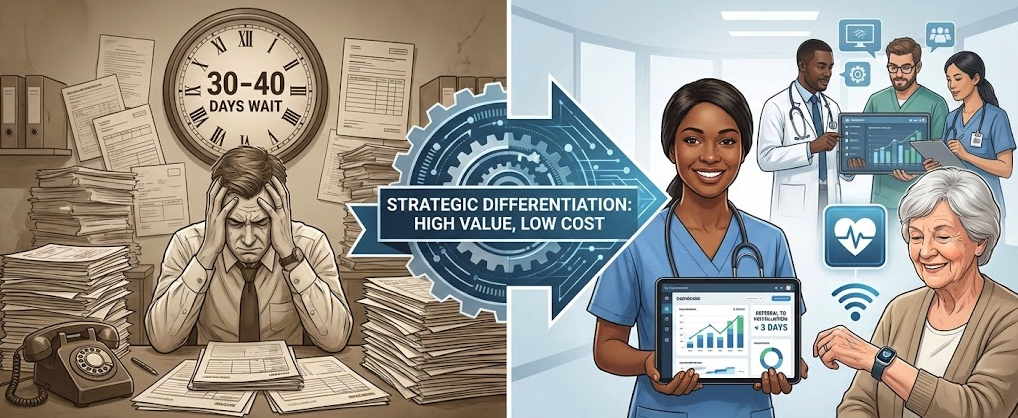
The challenge was stark: vulnerable people who wished to be referred for a Lifeline device often faced a waiting time of 30 to 40 days. Such a device is crucial because it helps care staff, families, and community volunteers support vulnerable people, alerting them instantly if the person has had an accident, like a fall. It is also incredibly useful to collect data and monitor certain conditions, like Epilepsy, or to simply track behaviours and notify if there are any new patterns, prompting medical professionals to check if cognitive conditions are progressing, or perhaps there is a need to review the patient’s care plan. Managing our daily work, I knew that regular practices aren’t sufficient - we needed a complete digital overhaul.
The Value of Swift Care: Technology Enabled Care
I spearheaded the deployment of a new business information solution centered around the Technology Enabled Care approach. The methodology reflects the mission of bringing social and healthcare closer to people: it combines social care, rehabilitation, pharmaceutical and medical staff, as well as technology professionals. There’s nothing quite as efficient as cross-functional collaboration, where transparent communication and progress tracking enable agile working and controlled change. We set an aggressive objective: to shorten and simplify that initial referral process and streamline urgent cases and hospital discharges to have their assessment-to-installation in less than 3 days. And it worked.
The value this system creates is multidimensional:
• For the Public and the NHS: The CCC Lifeline service significantly reduced demand on the NHS by ensuring patients were monitored from home sooner, reducing unnecessary GP and A&E visits.
• For the User: The person requesting the service - whether the patient or a family member - will be able to utilize technology to monitor the wellbeing and daily needs of their loved one.
• For Operations: The system instantly notifies the helpline provider if the technology installed in the patient’s house has a fault or error, allowing for quick action to fix the issue. In some cases, these perceived errors allowed us to better understand the specific needs of the patient and creatively solve these problems by swapping the equipment to a different provider or suggesting another approach altogether.
The result of this streamlined process is profound: by delaying admissions to residential care homes, nursing homes, and preventing hospital stays, we are effectively lowering spending for local social services and the NHS. This directly means saving taxpayers’ money that can then be reinvested into modernising hospital equipment, staff training, and improving our BIS infrastructure.
The Strategy: Using Bowman’s Differentiation
I believe that for any organization to survive and expand, even one owned by the Local Government, it needs a strategic advantage that differentiates it from competitors (Bocij, Greasley and Hickie, 2018). The strategy we applied was based on Bowman’s Strategic Differentiation (Bowman, 1958).
The competitive advantage of Technology Enabled Care solutions heavily relies on integrating relevant services and offering qualified professional help at a timely manner and at a low cost, often no cost at all for the customer, as it can also be government-funded. The integration of a universal, relevant BIS enables instantaneous access to healthcare records, social care information, and appropriate Emergency Response Services (ERS). Even though the cost of the service for the user is low, the perceived value is high. I believe this unique positioning is key to its success and sustainability.
The Role of Resilience and the Next Steps
As a professional, I am a master when it comes to coping with uncertainty, chaos, and stressful situations. My roles usually require constant crisis management, in this case - from troubleshooting end-user devices remotely to creatively adjusting technician routes to minimize disruptions. The ability to remain calm and focused under pressure ensures end-user satisfaction and minimized service disruptions. These are key factors to consider when thinking about good quality health and social care and how to build an effective team that delivers.
My expertise as an internal business analyst (which I was functioning as, despite my job title) meant I was constantly looking at our data and processes to identify bottlenecks and streamline operations. This operational rigor, combined with the strategic foresight of the medical technicians, care staff and project managers, allowed us to achieve a 20% increase in referral-to-installation efficiency for our regular cases. Needless to say, urgent patients and critical end-users were prioritized and would see their MedTech solutions within 24 to 48 hours.
\
I believe that the next wave of improvement will come through digital transformation and AI orchestration. We need to dedicate ourselves to learn, grow and democratise data, allowing us to build out comprehensive Power BI/Tableau or other reporting capabilities to drive business intelligence. It’s crucial to understand our performance and have transparency throughout the whole lifecycle of the project, as well as our day-to-day.I envision a future where an AI-powered app can support most languages, further improving accessibility and ensuring that our integrated social and healthcare service achieves the highest standards of care for all our patients and their families.
This project confirms that by integrating cutting-edge technology and sound business strategy, we can not only save significant resources but also profoundly enhance the quality of life for our most vulnerable citizens. And the best part? Public or private sector? It’s all transferable.